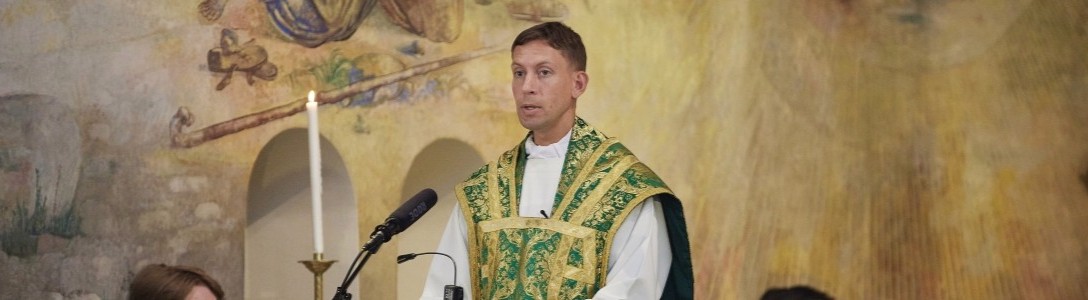
Högmässa på latin i Saint Cecilia’s Abbey, Ryde, Isle of Wight, England. Läsningar: Jes 55:1–3; Rom 8:35, 37–39; Matt 14:13–21.
Dear sisters and brothers,
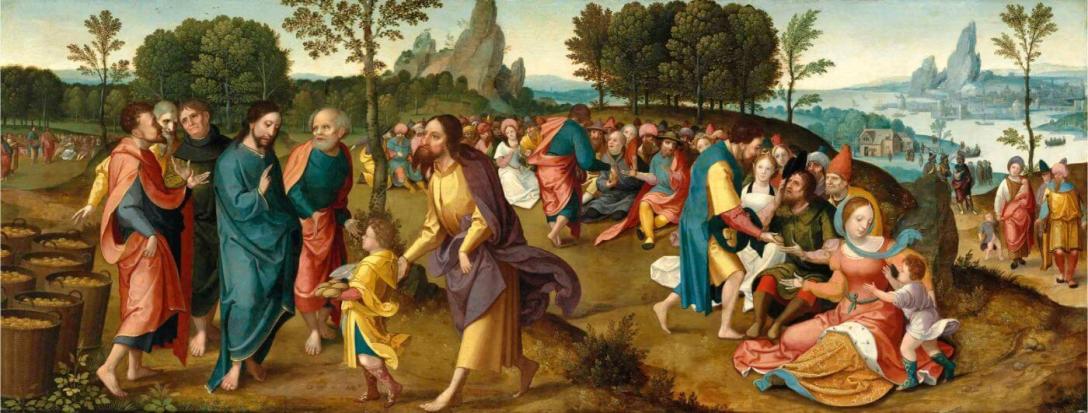
The Gospel story of the multiplication of the loaves that we have just heard is a prefiguration of the Eucharist, in that the superabundance of bread in this miracle prefigures that supersubstantial bread, which is the very Body of Christ. Next summer, during the year B of the lectionary readings, we will hear the same miracle as recorded in the Gospel of John. In that Gospel, the account of the miracle is followed by Jesus’ discourse on the bread of life, where he makes an explicit connection between the bread with which he has fed the multitude and the ”bread that [he] will give for the life of the world, [which] is [his] is flesh.” (Jn 6:51) In the Synoptic Gospels, the miracle of the multiplication of the loaves is left without a theological commentary by Jesus himself, but that doesn’t exclude that there are conscious references to the Eucharist in these Gospels, too.
In today’s Gospel, we heard Jesus ”taking the five loaves and the two fish”, that he ”said the blessing”, ”broke the loaves and gave them to the disciples” (Mt 14:19). All these four verbs, ”take”, ”bless”, ”break” and ”give” are also found in the institution narrative of the Eucharist, where it says that Jesus ”took bread, and after blessing it broke it and gave it to the disciples” (Mt 26:26). These four verbs also correspond to the four main moments of the liturgy of the Eucharist, namely the offertory, the eucharistic prayer, the breaking of bread and the communion. The Eucharist is at the same time a sacrifice and a meal – a sacrificial meal. But analogically, it can also be compared with other things. The Flemish-Swedish carmelite friar Wilfrid Stinissen, from the same convent in my home country Sweden as our Cardinal Anders Arborelius, he once compared the Eucharist to a tennis match between God and the Church, where they so to speak compete about who is able to give the best gift which the other is unable to match in giving something better in return, a little bit like tennis players take turns in trying to strike the ball over the net in such a way that the opponent is unable to return it. As you might know, our Holy Father, Pope Leo XIV loves to play tennis, and among his very first private audiences as a Pope last year, he received the world number one and recent Wimbledon champion Jannik Sinner. And it so happens that I myself was born in the same town as the five-time Wimbledon champion Björn Borg, namely Södertälje outside of Stockholm. Hopefully, Pope Leo will get the opportunity to relax by playing some tennis now during his summer vacation at Castel Gandolfo. And I am quite confident that he would approve of the following comparison between the Eucharist and a tennis match.
The first similarity between the Eucharist as a meal and the Eucharist as a tennis match is that in both cases, it is God who serves. In order to celebrate the Eucharist, we need the sacramental matter of bread and wine. These are provided by God himself, as we are reminded in Psalm 104: ”You cause the grass to grow for the livestock and plants for man to cultivate, that he may bring forth food from the earth and wine to gladden the heart of man, oil to make his face shine and bread to strengthen man’s heart.” (Ps 104:15) But in order to make bread out of wheat and wine out of grapes, the cooperation of human labour is also necessary. This is all the more obvious in this monastery, where the principal work carried out is exactly that of producing altar bread. It was the express will of Pope St. Paul VI that ”the work of human hands” be explicitly mentioned in the newly formulated offertory prayers in the reformed Missal. By adding this to the traditional Jewish blessing before meals, the current offertory prayers perfectly express what is going on at this moment of the Mass, namely that we offer to God the bread and the wine that we have received through his goodness, the fruit of the earth and the work of human hands, in order that they become the bread of life and our spiritual drink. This corresponds to the verb ”take” in the institution narrative.
After God has served us bread and wine which we have in our turn returned to him by setting them apart for sacred use during the offertory of the Mass, God returns them to us anew by making them become for us the Body and Blood of Christ, through the invocation of the Holy Spirit and the recitation of the institution narrative in the eucharistic prayer. The Church then, through the hands of the priest, immediately offers these gifts that God has given us, the Body and Blood of Christ, to God the Father as a pure, holy and spotless sacrifice. There is nothing more precious that we can offer to God the Father than the spotless sacrifice of his own Son, so the Eucharist is the highest form of adoration, or ascending blessing that we can give God, where we bless and thank him for all his benefits to us. The eucharistic prayer therefore corresponds to the verb ”bless” in the institution narrative. This blessing of God is especially expressed in the preface, which is to be considered an integral part of the eucharistic prayer.
The next verb in the institution narrative is ”break”. This of course corresponds to the rite of the breaking of bread, during which a small particle of the Body of Christ is mingled with the Blood of Christ. This has a twofold symbolism. During the double consecration of the bread and the wine, the Body of Christ is separated from his Blood, thereby signifying his death. Correspondingly, the mingling of the Body and Blood of Christ signifies his resurrection. The origin of this rite is the stational masses in Rome in the early Church, where particles of the Host consecrated by the Pope, the so-called fermentum, were brought to the other churches in the diocese and mingled in the chalice during Mass, as a very concrete way to express that the Eucharist is celebrated in communion with the Pope. With at least five bishops throughout the world having been ordained against the express will of the Pope last month, the need to be in full communion with the Pope in order for the Eucharist to be licit and fully pleasing to God cannot be overstated.
However, the original meaning of the breaking of the bread itself was of course the practical need to divide the bread transformed into the Body of Christ, in order for everyone to be able to partake of it. This rite was so significant in the early Church that it became one of the names to signify the eucharistic celebration in itself – the breaking of bread. With the introduction of small hosts in the 10th century in order to facilitate the distribution of communion, this aspect of the rite diminished in importance, but it is still desirable that the priest’s large host is shared with at least some of the faithful (cf. General Instruction of the Roman Missal, n. 321).
The last of the four eucharistic verbs, ”give” is also the last stroke of the eucharistic tennis match, and it refers of course to Holy Communion. As much as God is at the origin of everything, he also always gets the last word. After having offered the Body and Blood of Christ to God the Father in the eucharistic prayer, the Church receives Body of Christ anew through Holy Communion. Our need for food is a daily reminder of our totalt dependence of God. When we ask God in the ”Our Father” to ”give us this day our daily bread”, it refers just as much to the supersubstantial bread of Holy Communion as our daily ordinary food.
Let us ask for the grace to constantly grow in our understanding and appreciation of the Holy Eucharist, the sacrificial meal and divine tennis match, where we offer to God the bread and the wine that we have received through his goodness, which God in turn gives back to us after having transformed them into the Body and Blood of his Son, which the Church in turn offers to God the Father as a pure and spotless sacrifice, and which we finally receive in turn as divine food in Holy Communion, thereby little by little becoming even more what we already are – the Body of Christ. Amen.


