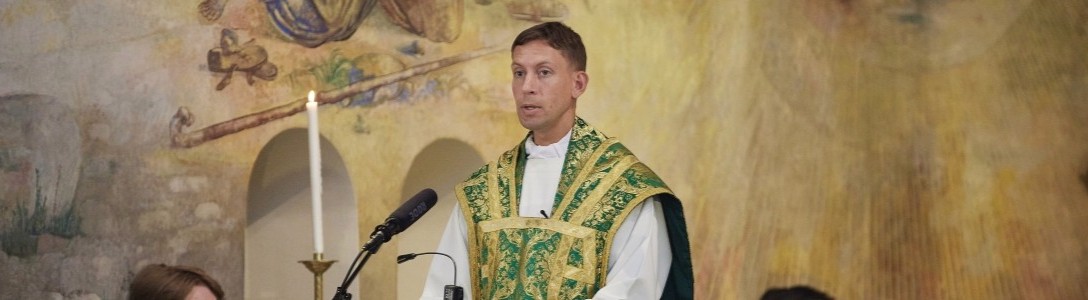
Mässa på engelska i Pluscarden Abbey, Skottland. Läsningar: Apg 12:1-11; Ps 34:2-9; 2 Tim 4:6-8, 17-18; Matt 16:13-19.
Dear brothers and sisters,
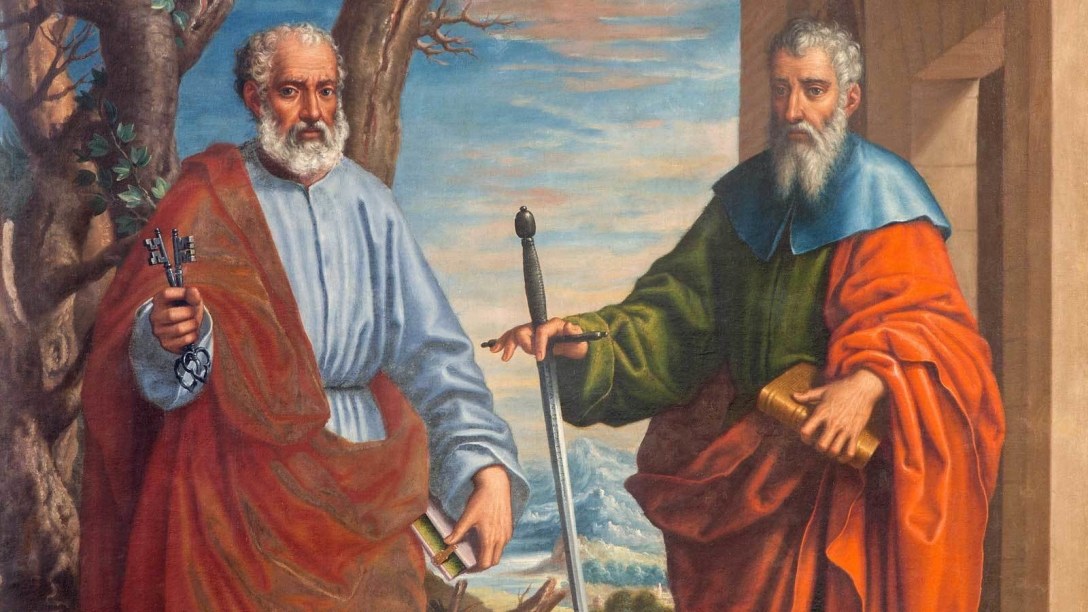
Today’s Solemnity of the Holy Apostles Peter and Paul is one of the most important celebrations of the liturgical year – so important that the Church has designated it a holy day of obligation on which all Catholics are obliged to attend Mass, even when it doesn’t, like this year, happen to falls on a Sunday. The reason for this is that the Solemnity of Saints Peter and Paul, patrons of the Church of Rome, powerfully expresses what it means to be in full communion with the One, Holy, Catholic, Apostolic and Roman Church – which is necessary in order to be sure of one’s eternal salvation.
The Second Vatican Council’s dogmatic constitution on the Church, Lumen Gentium, states that “Whosoever, therefore, knowing that the Catholic Church was made necessary by Christ, would refuse to enter or to remain in it, could not be saved” and “They are fully incorporated in the society of the Church who, possessing the Spirit of Christ accept her entire system and all the means of salvation given to her, and are united with her as part of her visible bodily structure and through her with Christ, who rules her through the Supreme Pontiff and the bishops” (n. 14). By “the Supreme Pontiff” is meant, of course, the Pope – successor of Peter as the Bishop of Rome, currently, since about a month and a half ago His Holiness Pope Leo XIV. Lumen Gentium further teaches that “The pope’s power of primacy over all, both pastors and faithful, remains whole and intact. In virtue of his office, that is as Vicar of Christ and pastor of the whole Church, the Roman Pontiff has full, supreme and universal power over the Church. And he is always free to exercise this power” (n. 22) In order to remain in full communion with the pope – and thus with the entire Catholic Church entrusted to his care – we must accept and adhere to his teachings with a religious assent. Lumen Gentium continues to explain that “This religious submission of mind and will must be shown in a special way to the authentic magisterium of the Roman Pontiff, even when he is not speaking ex cathedra; that is, it must be shown in such a way that his supreme magisterium is acknowledged with reverence, the judgments made by him are sincerely adhered to, according to his manifest mind and will (n. 25).”
This teaching on the Pope’s primacy is based on today’s Gospel, in which we heard Jesus say to Simon, the son of Jonah that “You are Peter, and on this rock I will build my Church, and the gates of hell shall not prevail against it. I will give you the keys of the kingdom of heaven” (Mt 16:18). This is a wonderful promise, not just to Peter himself but to the entire Church in every time and place – that the gates of hell will never prevail against it. By these words, Christ has promised the indefectibility of the Church through all times. This means that we can always be sure of remaining in the true faith if we remain in full communion with the Catholic Church of which the visible sign is communion with the Bishop of Rome, the successor of St. Peter, who is the guarantor of the Church’s unity in truth. However, there are, of course, also other Christian denominations, which do not draw the same conclusions from today’s Gospel. Let us therefore briefly consider what some of the early Church Fathers had to say about this.
By the end of the second century, St. Ireaneus of Lyon, in his work Against Heresies, referred to the “tradition derived from the apostles, of the very great, the very ancient, and universally known Church founded and organized at Rome by the two most glorious apostles, Peter and Paul”, and he concluded that “For it is a matter of necessity that every Church should agree with this Church, on account of its preeminent authority” (Against Heresies, Book III, chapter III). The first pope himself whose writings have been preserved and who clearly articulated and exercised the teaching of papal primacy was the current pope’s namesake, St. Leo the Great, who served as pope in the mid-fifth century. In a letter to the bishops of Vienne, he wrote that the Lord “has placed the principal charge on the blessed Peter, chief of all the Apostles: and from him as from the Head wishes His gifts to flow to all the body: so that any one who dares to secede from Peter’s solid rock may understand that he has no part or lot in the divine mystery” (Letter 10). And in a letter to Anastasius, bishop of Thessalonica, he wrote that “the care of the universal Church should converge towards Peter’s one seat, and nothing anywhere should be separated from its Head” (Letter 14).
The solemnity of Saints Peter and Paul also invites us to reflect on the great mercy that God showed these two great apostles. For both were great sinners, who experienced the Lord’s forgiveness through his call to conversion. When Simon Peter for the first time witnessed Jesus performing a miracle, that of the miraculous catch of fish, “he fell down at Jesus’ knees, saying: ‘Depart from me, for I am a sinful man, O Lord.’” (Lk 5:8) But Jesus nevertheless called him to follow him as an apostle and a “fisher of men”. Later on, during the Lord’s Passion, Peter denied three times that he even knew Jesus. But Jesus had foretold this, and had already confirmed Peter’s mission as the leader of the apostles by saying to him that “when you have turned again, strengthen your brothers” (Lk 22:32). And after Peter had atoned for his threefold denial by three times professing his love for Jesus, Jesus again confirmed his mission to tend his sheep (cf. Jn 21:15-17). Peter’s story reminds us that the Lord does not necessarily choose the best, those who never fall, even for the most important responsibilities in his Church. Therefore, we must never let our sins rob us of our confidence in the Lord’s great mercy, and never cease to love Him and seek His forgiveness.
St. Paul was arguably an ever greater sinner, albeit in good faith, since he even “persecuted the church of God” (1 Co 15:9). But after his vision of the risen Christ on the road to Damascus, which struck him blind, he humbled himself by fasting for three days, and when he regained his sight, he immediately let himself be baptized and began to proclaim that Jesus is the Son God (cf. Act 9:18,20). He would go on to become the most important missionary of all time, and to write roughly one fourth of the New Testament. Paul himself comments that “by the grace of God I am what I am, and his grace toward me was not in vain” (1 Co 15:10). The example of St. Paul reminds us that not only great sinners, but even former enemies of the Church, can be called to great missions by the Lord. I myself converted from Lutheranism to Catholicism back in 2006. In 2008, I attended my first World Youth Day in Sydney, Australia. When I visited the so-called vocational expo, I spoke with one of the priests presenting information about the priesthood. I mentioned that I was a convert, almost as a kind of objection to the idea of a vocation. The priest immediately replied: “Remember that Paul was a convert!”
Let us ask the Lord for the grace to always remain in full communion with his holy Catholic Church, firmly submitted to the successor of Peter, the Pope, and let us pray for the unity of all Christians in the one true faith. Let us also renew our trust in the Lord’s infinity mercy, remembering that even great sinners and persecutors of the Church can be called to great things, even, but not only, apostles and missionaries. Saint Peter and Saint Paul, pray for us. Amen.

 Fader Gustavs predikningar